Table of Contents
- Overview
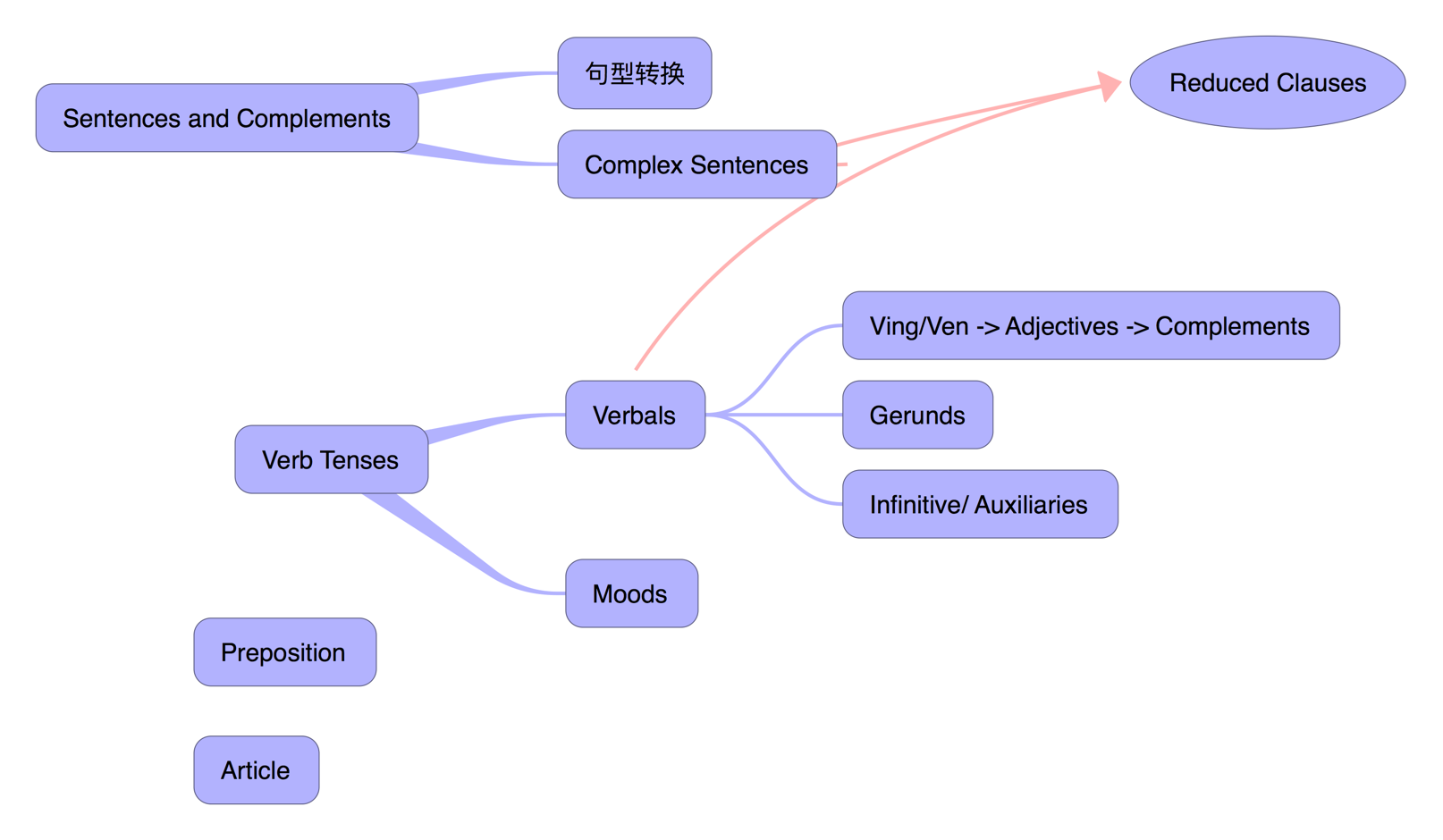
- Sentences & Complements
- Patterns Conversion
- Verb Tenses - Time(时) & Aspect(态)
- Verbals
- Moods
- Reduced Clauses
- Preposition
- Article
I. Overview
- This is my english grammar note depended on 旋元佑先生的<<英语魔法师之语法俱乐部>>
- 以下笔记是学习旋元佑先生的<<英语魔法师之语法俱乐部>>的学习笔记
II. Sentences & Complements
A. Five different verbs correspond to five basic sentence patterns (五种不同特性的动词对应五种基本句型)
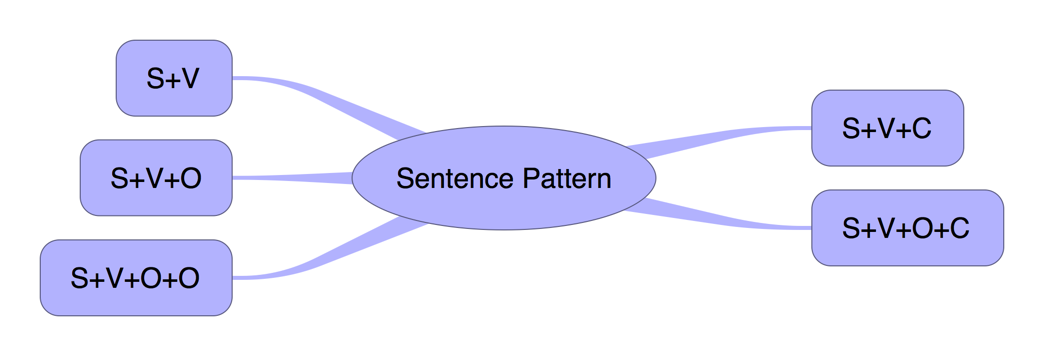
a. S+V (Intransitive Verb)
- John Smith died in World War Two.
b. S+V (Transitive Verb)+O
- John Smith killed three enemy soldiers.
c. S+V (Transitive Verb)+O+O
- John‘s father gave him a dog.
d. S+V (Linking Verb)+C
- The soup is too hot.
- John Smith was a soldier.
- John Smith was courageous.
- I feel sick.
e. S+V (Linking Verb)+O+C
- The food made me sick.
- Most people consider a nurse a good wife.
- I find the dress pretty.
- The meat made the dog friendly.
- John’s father called him a dog.
- His college training made him a teacher.
- I don’t find the drug bitter.
- I consider the story false.
- He found the trip exciting.
B. What are Linking Verbs (Followed by Complements or Objects + Complements) (链接动词跟补语)
In English, linking verbs can not be omitted. But when we translate them into Chinese, and also if the complements are adjectives, “是” will be omitted. (英语中Be动词在句子中不能省略, 但翻译成中文,如果补语是形容词,“是”会被丢弃)
- Taroko Gorge is beautiful. Taroko Gorge
_是_美丽的 - The soup is too hot. 汤
_是_太烫了
In addition to ‘Be’, What else are Linking Verbs.(除了Be, 还有哪些Linking Verb)
| 是 | Example | 为(是的文言文) | Example |
|---|---|---|---|
| look | That dress looks pretty. | turn(转变为) | |
| seem(似乎是) | The dog seems friendly. | prove(证实为) | The story proved false. |
| appear(显得是) | His demands appear reasonable. | become(成为) | He became a teacher. |
| sound | His trip sounds exciting. | make(作为) | A nurse make a good wife. |
| feel | I feel sick. | ||
| taste | The drug tastes bitter. |
Because these linking Verbs themselves have no abilities to describe something detail, so we must use complements to make sentences completed. There are two types of words can be complements. (Linking Verb本身没有叙述能力, 需要用Complement补足句子, 补语有两种词类)
- noun - the same relationship with the subject (表达与主语的同等关系)
- adjective
C. When “Be” is not a Linking Verb (Be不作为Linking Verb, 不解释为”是, 而是要解释为”存在”, 用在S+V句型中)
- I think, therefore I am. (René Descartes, 笛卡儿)
- To be or not to be, that is the question. (@Hamlet, 哈姆雷特)
III. Patterns Conversion
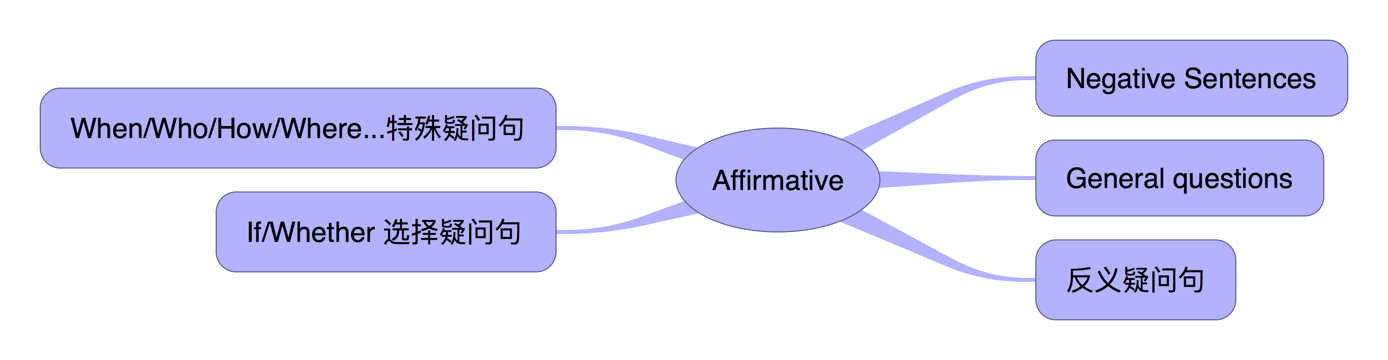
A. Affirmative Sentences (肯定句) → Negative Sentences (否定句)
- Be + Not
- I am a girl.
- → I am not a girl.
- You are a student.
- → You are not a student.
- → You aren’t a student.
- This is Tom’s bag.
- → This is not Tom’s bag.
- → This isn’t Tom’s bag.
- I am a girl.
- Add Negative Form of Auxiliary (don’t/doesn’t/didn’t) before Transitive Verbs (及物动词)/Intransitive Verbs (不及物动词)(在动词前加助动词的否定形式, don’t/doesn’t/didn’t)
- They really know what will happen.
- → They really don’t know what will happen.
- Someone know what he/she is missing.
- → Someone doesn’t know what he/she is missing.
- I want to write this.
- → I didn’t want to write this, but the courage to listen to different ideas is vanishing
- They really know what will happen.
- Auxiliary + Not, can not/should not/will not
- Trump can keep his corruption hidden forever.
- → Trump cannot keep his corruption hidden forever.
- You should do that.
- → You should not do that.
- Turkey will back down due to US sanctions.
- → Turkey will not back down due to US sanctions.
- → Turkey won’t back down due to US sanctions.
- Trump can keep his corruption hidden forever.
- some → any
- I got some nice presents for Christmas this year.
- → I didn’t get any nice presents for Christmas this year.
- I’d like to go somewhere hot this summer.
- → I’m not hungry. I don’t want anything to eat.
- I got some nice presents for Christmas this year.
B. Affirmative Sentences → 一般疑问句 (General Questions)
- Put “Be” at the begin of the sentence (Be动词放在句首)
- I am in Class 6.
- → Are you in Class 6?
- There are some apples.
- → Are there any apples?
- I am in Class 6.
- Under the Transitive verbs/Intransitive verbs, put “Do/Does/Did” at the begin of the sentence
- I like red.
- → Do you like red?
- He wants to play soccer with friends.
- → Does he want to play soccer with friends?
- We finished our homework before nine yesterday.
- → Did you finish your homework before nine yesterday?
- I like red.
- Put auxiliary(can/shall/will/…) at the begin of the sentence
- I will go to hospital tomorrow.
- → Will you go to hospital tomorrow?
- He can climb the tree.
- → Can he climb the tree?
- I will go to hospital tomorrow.
- some → any
- We can use some in questions when offering/requesting:
- Would you like some more tea?
- Could I have some milk, please?
- Do you want something to eat?
- We use any in positive sentences when we mean it doesn’t matter which ..:
- You can come and ask for my help any time.
- Which book shall I read? - Any one. It’s up to you.
- You can sit anywhere but here. This is my seat!
- We can use some in questions when offering/requesting:
C. Affirmative Sentences → Information Questions (特殊疑问句)
- Underline a question part (划出提问部分)
- Use a question word to replace this underline, put the question word at the begin of the sentence, and add auxiliary if needed, then exchange the position with the subject (用疑问词替代划线部分, 并移到句首)
- And add auxiliary if needed, then exchange the position with the subject (加助动词, 并颠倒主谓)
- Mike is
a worker.- → What is Mike?
- He is ~~my brother~.
- → Who is he?
- The box is
on the desk.- → Where is the box?
- It’s
seven twenty.- → What time is it?
- I usually get up
at six.- → When do you usually get up?
- I am
twelve.- → How old are you?
- My hat is
blu.- → What color is your hat?
- I can see
five kites.- → How many kites can you see?
- There is
some milkin the glass.- → How much milk is there in the glass?
1* This pen isnine yuan. - → How much is this pen?
1* That ismy book. - → Whose book is that?
1* The bag isyours. - → Whose is the bag?
- → How much milk is there in the glass?
- Mike is
- If the question word is subject, then keep the position (如果疑问词作主语(Subject)或主语的定语, 语序保持陈述句的语序)
- He is
my brother.- → Who is he?
Heis my brother.- → Who is my brother?
- He is
IV. Verb Tenses
A. Simplify (以简驭繁的方式)
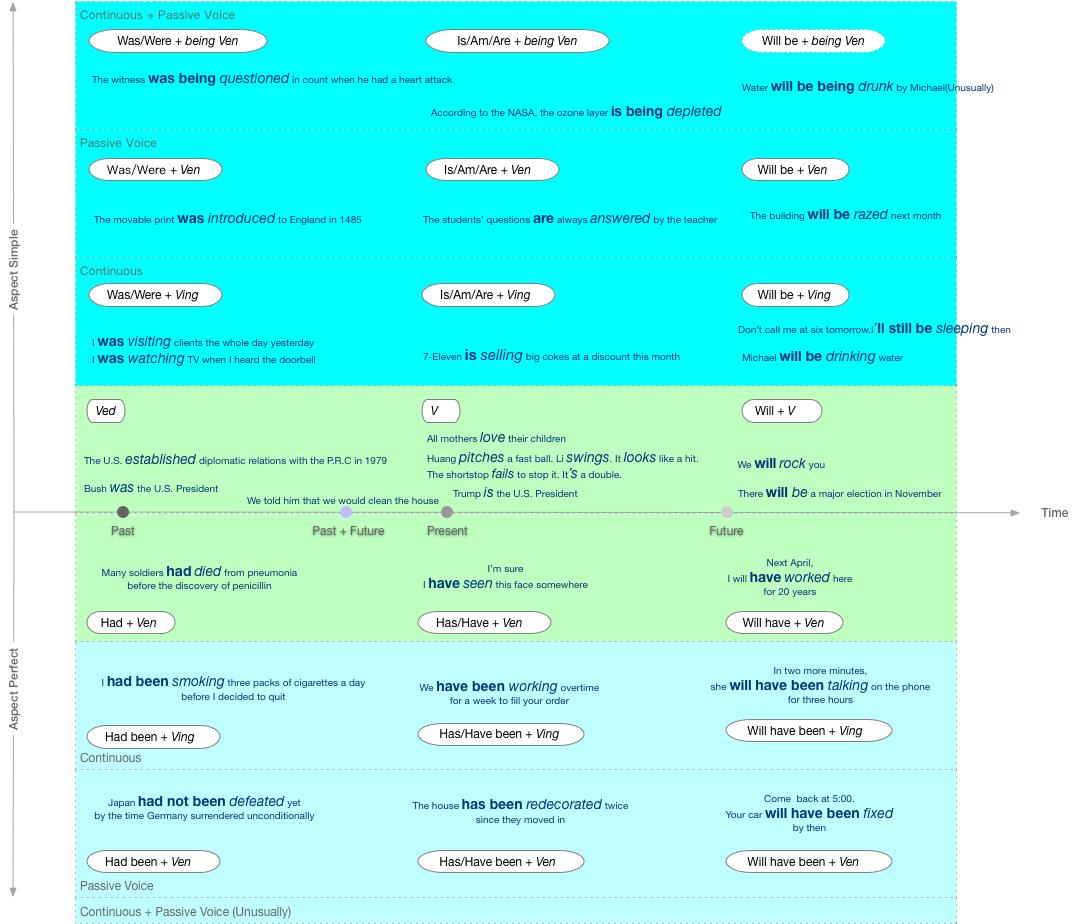
One sentence only has two aspects, simple and perfect. Add “Be” or “Have/has been” before the original verb. Replace original verb with present participle(Ving) to describe in progress, and replace original verb with past participle(Ven) to describe passive voice.
Time(Past/Present/Future)和Aspect分开处理
- 当需要表达进行或被动语态时, 把Be动词当作动词, 句子只有两种Aspect状态(简单态与完成态), 其后的现代分词(Ving)和过去分词(Ven)视为形容词补语, Ving表示Continuous, Ven表示Passive Voice
- 根据Time和Aspect变换Be动词
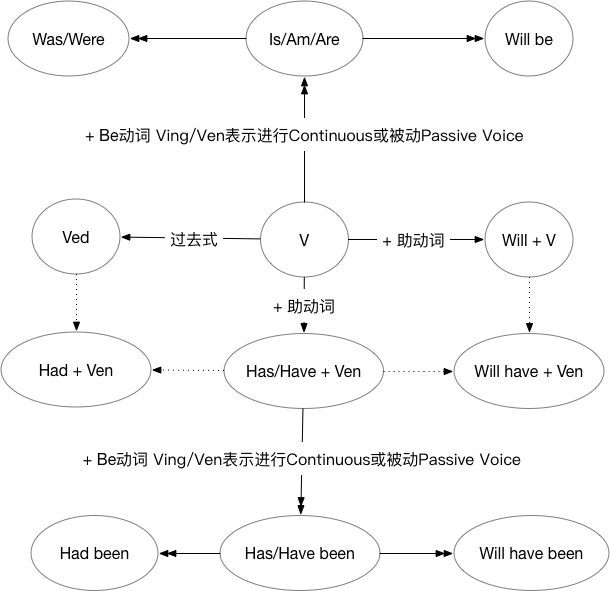
B. Simple
a. Past
- Ved
- The U.S. established diplomatic relations with the P.R.C in 1979.
- Bush was the U.S. President.
- Was/Were + Ving
- I was visiting clients the whole day yesterday.
- I was watching TV when I heard the doorbell.
- Was/Were + Ven
- The movable print was introduced to England in 1485.
- Was/Were + being Ven
- The witness was being questioned in count when he had a heart attack.
- The house was being painted when we arrived.
b. Present
- V
- All mothers love their children.
- Huang pitches a fast ball. Li swings. It looks like a hit.
The shortstop fails to stop it. It’s a double. - Trump is the U.S. President.
- Is/Am/Are + Ving
- 7-Eleven is selling big cokes at a discount this month.
- Is/Am/Are + Ven
- The students’ questions are always answered by the teacher.
- Is/Am/Are + being + Ven
- According to the NASA, the ozone layer is being depleted.
- How is the new teaching method being tried there.
c. Future
- Will + V
- We will rock you.
- There will _be_ a major election in November.
- Will be + Ving.
- Don’t call me at six tomorrow. I’ll still be sleeping then.
- Michael will be drinking water.
- Will be + Ven
- The building will be razed next month.
Will be + being Ven(Unusually)Water will be being drunk by Michael.
d. Past Future
- We told him that we would clean the house.
C. Perfect
a. Past
- Had + Ven
- Many soldiers had died from pneumonia before the discovery of penicillin.
- Had been + Ving
- I had been smoking three packs of cigarettes a day before I decided to quit.
- Had been + Ven
- Japan had not been defeated yet by the time Germany surrendered unconditionally.
b. Present
- Has/Have + Ven
- I’m sure I have seen this face somewhere.
- Has/Have been + Ving
- We have been working overtime for a week to fill your order.
- Has/Have been + Ven
- The house has been redecorated twice since they moved in.
c. Future
- Will have + Ven
- Next April, I will have worked here for 20 years.
- Will have been + Ving
- In two more minutes, she will have been talking on the phone for three hours.
- Will have been + Ven
- Come back at 5:00. Your car will have been fixed by then.
V. Verbals
| Type | Pattern | Part of Speech | Role in Sentence | Example |
|---|---|---|---|---|
| Present Participle (现在分词) | Ving | Adjectives (形容词) | Complements | |
| Past Participle (过去分词) | Ven | Adjectives (形容词) | Complements | |
| Gerunds (动名词) | Ving | Nouns (名词) | Subjects/Objects/Complements | |
| Infinitive (不定式短语) | to do | Nouns | Subjects/Objects/Complements | |
| Adjectives | Subjects/Objects/Complements | |||
| Adverbials | 修饰动词或形容词 |
A. Infinitive
a. From Auxiliaries to Infinitive (从助动词演变到不定式短语)
- I am glad because I can know you. S+V+C(Clause)
- → I am glad because I am able to know you. Auxiliaries → be able to
- → I am glad
because I am ableto know you. Conjunction, Subject and Be are omitted
- → I am glad
- → I am glad because I am able to know you. Auxiliaries → be able to
| Auxiliaries | Infinitive |
|---|---|
| must | have to |
| should | ought to |
| will/would | be going to |
| can/could | be able to |
| may/might | be likely to |
b. Have an uncertain tone (都有不确定的语气)
- He is right. 他是对的
- He may be right. 他可能式对的
- He seems to be right. 他好像是对的
c. Use the Perfect to Express the Past (都是用完成式来表达相对过去的时间)
- In Progress (现在进行中)
- It must be raining now. 现在一定下雨了
- Future Speculation (未来的推测)
- It may rain any minutes.
- It might even snow。
- Speculation about the past (对过去的推测)
- It must have rained last night. 昨晚一定下过雨了
- It seems to have rained last night. 昨晚好像下过雨
c. Infinitive VS Gerund
- plan
- They plan that they will marry next month.
- → They plan
that they areto marry next month.- → They plan to marry next month.
- → They plan
- They plan that they will marry next month.
- avoid
- I avoid making the same mistake twice.
- hate
- I hate I must say, but I think you’re mistaken.
- → I hate
I haveto say, but I think you’re mistaken.- → I hate to say this, but I think you’re mistaken.
- → I hate
- I hate I must say, but I think you’re mistaken.
- like/dislike
- I like to be the first.
- I don’t like to wait too long.
- I dislike standing in long lines. dislike没有”必须”(have to)的暗示
- try
- I always try to be on time.
- Why don’t you try being late for a change? 你何不故意迟到一次呢?
- remember
- Please remember to give me a wake-up call at 6:00 tomorrow.
- I remember calling her at 6:00 last night.
- shop
- The speaker stopped talking at the second bell.
- The speaker stopped a second to drink some water.
- Verbs Followed by Gerunds www.englishpage.com
- 9 = verb followed by a gerund OR a noun + an infinitive
- 13 = verb followed by a gerund OR an infinitive with a difference in meaning
- 14 = verb followed by a gerund OR an infinitive with little difference in meaning
| verb | example |
|---|---|
| admit | He admitted cheating on the test. |
| advise [9] | The doctor generally advised drinking low-fat milk. |
| allow [9] | Ireland doesn’t allow smoking in bars. |
| anticipate | I anticipated arriving late. |
| appreciate | I appreciated her helping me. |
| avoid | He avoided talking to her. |
| begin [14] | I began learning Chinese. |
| can’t bear [14] | He can’t bear having so much responsibility. |
| can’t help | He can’t help talking so loudly. |
| can’t see | I can’t see paying so much money for a car. |
| can’t stand [14] | He can’t stand her smoking in the office. |
| cease [14] | The government ceased providing free healthcare. |
| complete | He completed renovating the house. |
| consider | She considered moving to New York. |
| continue [14] | He continued talking. |
| defend | The lawyer defended her making such statements. |
| delay | He delayed doing his taxes. |
| deny | He denied committing the crime. |
| despise | She despises waking up early. |
| discuss | We discussed working at the company. |
| dislike | She dislikes working after 5 PM. |
| don’t mind | I don’t mind helping you. |
| dread [13] | She dreads getting up at 5 AM. |
| encourage [9] | He encourages eating healthy foods. |
| enjoy | We enjoy hiking. |
| finish [13] | He finished doing his homework. |
| forget [13] | I forgot giving you my book. |
| hate [14] | I hate cleaning the bathroom. |
| imagine | He imagines working there one day. |
| involve | The job involves traveling to Japan once a month. |
| keep | She kept interrupting me. |
| like [14] | She likes listening to music. |
| love [14] | I love swimming. |
| mention | He mentioned going to that college. |
| mind | Do you mind waiting here for a few minutes. |
| miss | She misses living near the beach. |
| need [13] | The aquarium needs cleaning. |
| neglect [14] | Sometimes she neglects doing her homework. |
| permit [9] | California does not permit smoking in restaurants. |
| postpone | He postponed returning to Paris. |
| practice | She practiced singing the song. |
| prefer [14] | He prefers sitting at the back of the movie theater. |
| propose [14] | I proposed having lunch at the beach. |
| quit [13] | She quit worrying about the problem. |
| recall | Tom recalled using his credit card at the store. |
| recollect | She recollected living in Kenya. |
| recommend | Tony recommended taking the train. |
| regret [13] | She regretted saying that. |
| remember [13] | I remember telling her the address yesterday. |
| report | He reported her stealing the money. |
| require [9] | The certificate requires completing two courses. |
| resent | Nick resented Debbie’s being there. |
| resist | He resisted asking for help. |
| risk | He risked being caught. |
| start [14] | He started studying harder. |
| stop [13] | She stopped working at 5 o’clock. |
| suggest | They suggested staying at the hotel. |
| tolerate | I tolerated her talking. |
| try [13] | Sam tried opening the lock with a paperclip. |
| understand | I understand his quitting. |
| urge [9] | They urge recycling bottles and paper. |
- Verbs Followed by Infinitives www.englishpage.com
- 8 = verb followed by an infinitive OR an optional noun + an infinitive
- 13 = verb followed by a gerund OR an infinitive with a difference in meaning
- 14 = verb followed by a gerund OR an infinitive with little difference in meaning
| verb | example |
|---|---|
| agree | Tom agreed to help me. |
| appear | His health appeared to be better. |
| arrange | Naomi arranged to stay with her cousin in Miami. |
| ask [8] | She asked to leave. |
| begin [13] | He began to talk. |
| can’t bear [14] | He can’t bear to be alone. |
| can’t stand [14] | Nancy can’t stand to work the late shift. |
| care | He doesn’t care to participate in the activity. |
| cease [14] | The government ceased to provide free healthcare. |
| choose [8] | I chose to help. |
| claim | She claimed to be a princess. |
| continue [14] | She continued to talk. |
| decide | We decided to go to Hawaii. |
| demand | He demanded to speak to Mr. Harris. |
| deserve | He deserves to go to jail. |
| dread [13] | I dread to think what might happen. |
| expect [8] | They expect to arrive early. |
| fail | He failed to get enough money to pay for the new project. |
| forget [13] | I forgot to lock the door when I left. |
| get (be allowed to) | Debbie gets to go to the concert next week! Why can’t I? |
| happen | She happened to be at the bank when it was robbed. |
| hate [14] | He hates to clean dishes. |
| hesitate | She hesitated to tell me the problem. |
| hope | I hope to begin college this year. |
| intend | We intend to visit you next spring. |
| learn | I learned to speak Japanese when I was a kid. |
| like [14] | Samantha likes to read. |
| love [14] | We love to scuba dive. |
| manage | He managed to open the door without the key. |
| need [8,13] | I need to study. |
| neglect [14] | She neglected to tell me the date of the meeting. |
| offer | Frank offered to drive us to the supermarket. |
| plan | We plan to go to Europe this summer. |
| prefer [14] | He prefers to eat at 7 PM. |
| prepare [8] | They prepared to take the test. |
| pretend | The child pretended to be a monster. |
| promise [8] | She promised to stop smoking. |
| propose [14] | Drew proposed to pay for the trip. |
| refuse | The guard refused to let them enter the building. |
| regret [13] | I regret to inform you that your application was rejected. |
| remember [13] | Did you remember to lock the door when you left? |
| seem | Nancy seemed to be disappointed. |
| start [13] | Marge started to talk really fast. |
| swear | She swore to tell the truth. |
| tend | He tends to be a little shy. |
| threaten [8] | He threatened to leave forever. |
| try [13] | Mary tried to lift the table, but it was too heavy. |
| vow | He vowed to get revenge. |
| wait | She waited to buy a movie ticket. |
| want [8] | I want to study Spanish. |
| wish [8] | I wish to stay. |
| would like [8] | (meaning “wish” or “want”) We would like to start now. |
| yearn | Melanie yearns to travel somewhere exotic. |
B. Causative Verbs and Original Form(使役动词和动词原型)
- The teacher made the little girl stay behind.
- Causative verbs like “let/have/make/…” are followed by original forms of verbs, because their results are not uncertain, and can not be followed by infinitives
- let/have/make等使役动词, 后面是接原型动词, 是因为它的结果不具有不确定性, 因而不能用不定式
- The teacher asked the little girl to stay behind.
- John had his car painted over.
- Causative Verbs can also be followed by Ven (并不是使役动词后面只能用原型)
C. Verbs of Perception and Original Form (感官动词和动词原型)
- I heard her playingthe violin.
- Verbs of Perception can only be used in what really happened, they come with present participle
- 感官动词see/hear/watch, 只能配合确实发生过的事情, 可以和现在分词一起使用.
- I heard her cry out in pain.
- 大叫一声, 叫声并不能持续, 所以不能用现在分词. 既不能用不定式, 也没有被动的语态, 所以只好用动词原型了
D. Gerunds
VI. Moods
A. Indicative (叙述事实的语气)
a. Now or in the past, true and false can be determined, so use the tone of narrative facts. The future has not yet happened. Strictly speaking, it is still not certain whether it is true or false. This is why adding the auxiliary verb before the verb in the future mode. Because the auxiliary verbs are uncertain. (现在和过去的事情, 真假已经可以确定, 所以用叙述事实的语气. 未来的事情还没有发生, 严格说来还不能确定真假, 这就是为啥未来式要在动词前加上助动词will, 因为助动词都带有不确定性.)
- He went to the U.S. last year.
- I will go to the U.S. next year to study for an MBA degree.
b. Can be calculated by formula, can be described as facts (可以用公式计算出来, 可以当作事实来叙述)
- The weatherman says sunrise tomorrow is at 5:32.
- The movie starts in 5 minutes. 同上
c. The clause describes two things in the future. It is necessary to assume that one of them is a fact, and then we can infer another one. So the clause uses the present form. (主从句同时叙述两件未来的事情, 需要先假定其中一件是事实, 才能推论另外一件. 所以从句用现在式)
- I’ll be ready when he comes.
- If you are late again, you will be fired.
B. Conditional (条件语气)
a. Adding an auxiliary verb to a sentence, producing an indeterminate tone, called conditional tone (句子中加上助动词, 产生不确定的语气, 称为条件语气)
- You are right.
- → You may be right.
- The doctor thinks it can be AIDS.
- → It could be anything - AIDS or a common cold.
b. Use the perfect expression to infer which happened in the past (用完成式表达对过去的猜测)
1 | must → should |
- It may rain any minute now.
- → It may have rained a little last night.
C. Subjunctive (假设语气)
| Time | 从句 | 主语 |
|---|---|---|
| 要把假设条件当真, 所以不能用表示不确定性的助动词 | 在一个假定条件下”就会/就可能”有啥结果, 所以用过去拼法的助动词 | |
| 现在时间 | 现在式 → 过去式 | 过去拼法的助动词 + V(动词原型) |
| If I were you | I wouldn’t do it | |
| If I were to take the bribe | I could never look at other people in the eye again | |
| 过去时间 | 过去式 → 过去完成式 | 过去拼法的助动词 + have + Ven(完成) |
| If I had known earlier | I might have done something | |
| If the bear had been more than just curious | Things might have turned out a little differently | |
| 未来时间 | 过去拼法的助动词 + V(动词原型) | 过去拼法的助动词 + V(动词原型) |
| 未来时间接近条件语气, 表示不确定的语气 | If an asteroid should hit the earth | man could die out |
| If I should take the money | could you guarantee secrecy | |
| 过去 + 现在 | If I had studied harder in school | I could qualify for the job now |
| 混合真假 | If I had have any money with me(false) → only that I didn’t have any money with me(true) | I could have contributed to the fund drive then |
| 句型变换 | It’s time you kid were in bed | |
| If only I had more time! | ||
| I wish I had more time! |
D. Imperative (祈使语气)
VII. Reduced Clauses
A. 通用规则
a. 省略从句中的主语和Be动词, 只留补语
- Whether
it isinsured or not(副词从句), your house,which isa wooden building(形容词从句), needs a fire alarm.- → Whether insured or not, your house, a wooden building, needs a fire alarm.
- It is common courtesy
that one should( → isto)wear black(名词从句) whileone attends( → isattending)a funeral(副词从句).- → It is common courtesy to wear black while attending a funeral.
b. 没有Be动词如何处理
- 有助动词 → 不定式
- He studied hard so that he could get a scholarship.
- → He studied hard
so that he was (able)to get a scholarship. - → He studied hard to get scholarship.
- → He studied hard
- 省略后意思如果不清楚可以如此补充
- He studied hard so as to get scholarship.
- He studied hard in order to get a scholarship.
- He studied hard so that he could get a scholarship.
- 没有助动词 → Ving
- John remembers that he saw the lady before.
- → John remembers seeing the lady before.
- John remembers that he saw the lady before.
B. 形容词从句(关系从句)的简化
a. 补语为Ven
- Beer which is chilled to 6 ℃ is most delicious.
- → Beer chilled to 6 ℃ is most delicious.
- Your brother John, who was wounded in war, will soon be sent home.
- → Your brother, wounded in war, will soon be sent home.
b. 补语为Ving
- The ship which is coming to shore is from Gaoxiong.
- → The ship coming to shore is from Gaoxiong.
- My old car, which break down every other week, won’t last much longer.
- → My old car, breaking down every other week, won’t last much longer.
👉 通用规则b
- → My old car, breaking down every other week, won’t last much longer.
c. 补语为不定式
- John is the one who should go this time.
- → John is the one to go this time.
- 关于不定式主动和被动的问题, 下面两句都是👌的
- John is not a man
whomone can trust- → John is not a man one can trust
- → John is not a man to trust.
- John is not a man who can be trusted
- → John is not a man to be trusted.
- John is not a man
d. 补语为形容词或名词
- Hilary Clinton, who is pretty and intelligent, is a popular First Lady.
- → Hilary Clinton, pretty and intelligent, is a popular First Lady.
- Bill Clinton, who is President of the U.S., is a Baby Boomer.
- → Bill Clinton, President of the U.S., is a Baby Boomer.
C. 名词从句的简化
a. 简化后剩下的补语式Ving形态时
- That I drink good wine with friends is my greatest enjoyment.
- → Drinking good wine with friends is my greatest enjoyment.
- Many husbands enjoy that they do the cooking.
- → Many husbands enjoy doing the cooking.
- He got used to(介词) working late into the night.
- His favorite pastime is that he goes fishing on weekend.
- → His favorite pastime is going fishing on weekend.
- 主语不能够省略
- S+V+O+C
- I imagined that a beautiful girl was singing to me.
- →
I imagined singing to myself. - → I imagined a beautiful girl singing to me.
- →
- I imagined that a beautiful girl was singing to me.
- 用所有格
- That he calls my girlfriend every day is too much for me.
- →
Calling my girlfriend every day is too much for me. - → His calling my girlfriend every day is too much for me.
- →
- That he calls my girlfriend every day is too much for me.
- S+V+O+C
b. 简化后剩下的补语式Ven形态时, 无法取代名词
- That anyone is called a liar is the greatest insult.
- →
Called a liar is the greatest insult.(Wrong) - → Being called a liar is the greatest insult.
- →
- I am looking forward to(介词) being invited to the party
c. 名词从句中是单纯的be动词
That one is a teacher requires a lot of patience.
- → Being a teacher requires a lot of patience.
That he was busy is no excuse for the negligence.
- → Being busy is no excuse for the negligence.
d. 简化后剩下的补语是to V形态
The children expect that they can get presents for Christmas.
- → The children expect to get presents for Christmas.
I think it strange that man should fear ghosts.
- → I think it strange to fear ghosts.
主语不合适省略
- I want that you should go.
- → I want you to go.
- I want that you should go.
e. 疑问句的名词从句简化, 疑问词要保留, where to/how to/when to
I don’t known what I should do.
- → I don’t known what to do.
I can’t decide whether I should vote for Mary(or not).
- → I can’t decide whether to vote for Mary.
D. 副词从句的简化
a. 简化为Ving补语
- While he was lying on the couch, the boy fell asleep.
- →
Whilelying on the couch, the boy fell asleep.
- →
b. 没有Be动词与助动词时
- Because we have nothing to do here, we might as well go home.
- → Having nothing to do here, we might as well go home.
- Although we have nothing to do here, we can’t leave early.
- → Although having nothing to do here, we can’t leave early. 这种相反的逻辑关系要用although来表示, 所以although不能省略
- → Having nothing to do here, we still can’t leave early.
c. 副词从句中的动词单纯是Be
- As I am a student, I can’t afford to get married.
- → Being a student, I can’t afford to get married.
- → As a student, I can’t afford to get married.
- Before he was in school, he used to be a naughty child.
- → Before being in school, he used to be a naughty child.
d. 时态的问题
- After he wrote the letter, he put it to mail.
- → After writing the letter, he put it to mail.
- →
Writing the letter, he put it to mail.(Wrong) - → Having written the letter, he put it to mail.
- When he had written the letter, he put it to mail.
- → Having written the letter, he put it to mail.
VIII. Preposition
A. Space
a. spot → at
- Let’s meet at the railway station.
b. line → on, along
- Then we can go over the project on our way to Gaoxiong.
- We may go walking through the windy park, or drive along the beach.
c. face → on
- Several boats can be seen on the lake.
- on the internet/on Facebook/on Twitter
d. cube → in
- It’s cool in the railway station, because they have air-condition.
B. Time
a. moment → at
- The earthquake struck at 5:27AM
b. during → in
- Typhoon seldom come in Winter.
c. special time → on
- There’ll be a concert on New Year’s Day.